
LATEST NEWS AND UPDATES
Unlock your professional potential with Pro Insights!
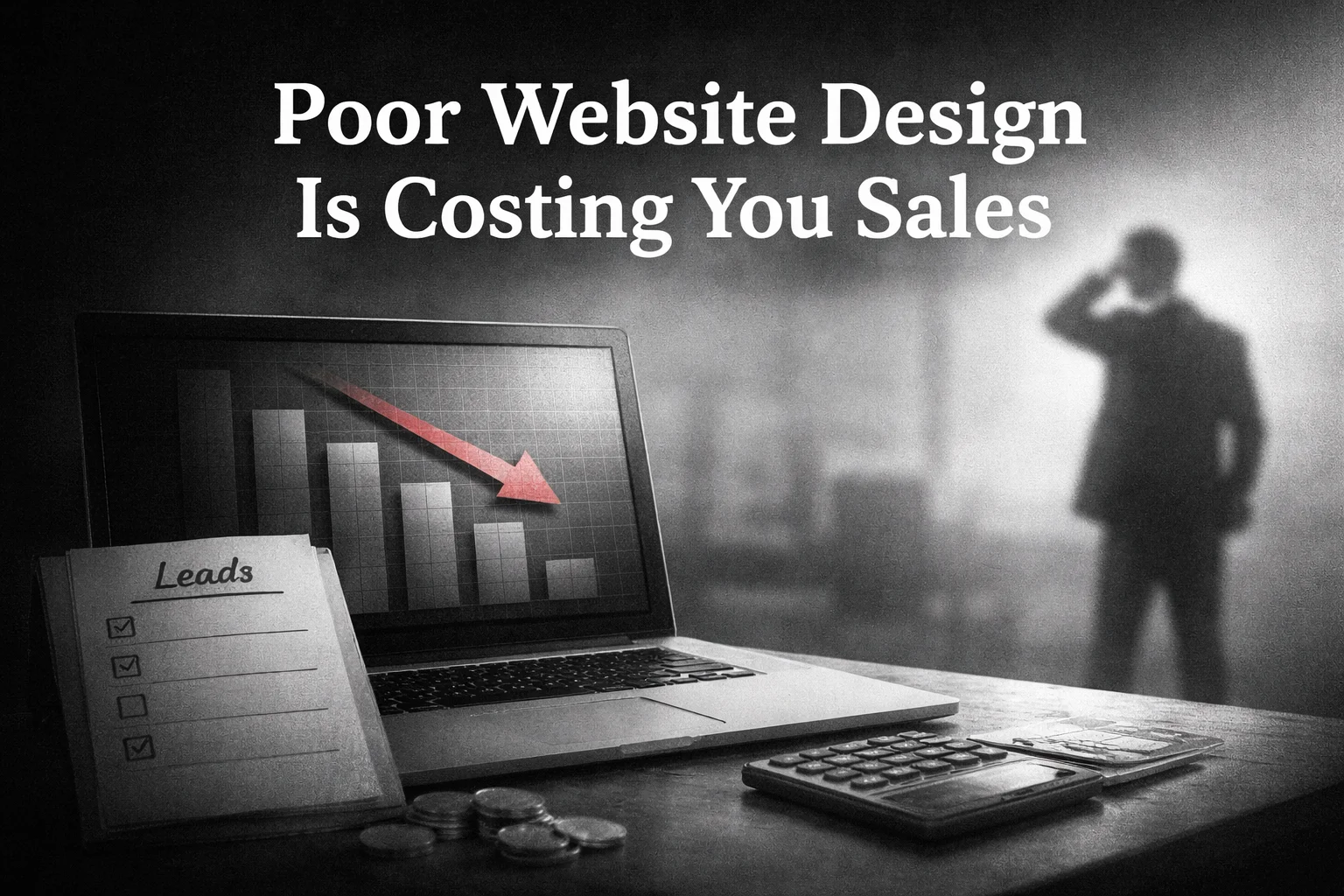
Poor Website UX Is Costing You Sales Leads

The Problem Most Businesses Misdiagnose
Poor website design rarely announces itself.
There’s no error message.
No sudden crash.
No clear moment where sales stop.
Instead, it shows up as hesitation. Drop-off. Lost confidence.
When a website doesn’t convert, most businesses assume they need more traffic. In reality, the problem is usually structural. The website design isn’t supporting the decision a visitor is trying to make.
A Website Is Not Content. It’s Infrastructure.
A website is where business decisions are tested.
Before someone contacts you, buys from you, or trusts you, they assess:
-
Clarity
-
Credibility
-
Effort required to understand you
-
Risk
If your website design introduces friction at any of those points, sales don’t stall — they quietly disappear.
Not because the offer is weak.
Because the system is.
Where Poor Website Design Costs You Sales
Most revenue loss happens before a form is ever seen.
Common failure points:
-
Pages that explain too much, too slowly
-
Navigation that forces visitors to think instead of move
-
Visual inconsistency that weakens credibility
-
Layouts built for aesthetics, not decisions
-
Mobile experiences treated as an afterthought
None of these feel dramatic.
Together, they are expensive.
This is why high-performing websites don’t focus on persuasion first. They focus on removing doubt.
Design Decisions Shape Buying Behaviour
People don’t buy when they’re convinced.
They buy when uncertainty is resolved.
Research consistently shows that users judge credibility and trustworthiness within seconds of landing on a site. The Nielsen Norman Group, a leading authority on usability and user behaviour, has documented how layout, hierarchy, and clarity directly influence whether users stay, engage, or leave. Nielsen Norman Group
This isn’t about trends or creativity.
It’s about decision friction.
Poor website design increases it.
Good design removes it.
Why “DIY” Websites Struggle To Sell
Tools have made building websites easier.
They have not made designing effective websites easier.
Templates optimise for speed, not strategy.
They prioritise assembly over alignment.
Without clear thinking behind structure, messaging, and hierarchy, the result is often a site that looks finished but doesn’t perform.
This is where many businesses get stuck:
-
The website exists
-
It functions
-
But it doesn’t earn
That gap is where sales are lost.
Traffic Won’t Fix A Broken System
More visitors won’t compensate for poor design decisions.
If the structure doesn’t guide action, increased traffic simply increases leakage. Every visitor who leaves confused is not a missed click — it’s a missed opportunity compounded.
Before investing in ads, SEO, or content, the question should be simpler:
Does this website make choosing us easier?
If not, growth efforts amplify the wrong thing.
Design Is A Business Decision
Website design is not decoration.
It’s how you decide to present risk, value, and clarity.
When it’s treated as a visual exercise, sales suffer.
When it’s treated as infrastructure, performance follows.
If you want to understand how we approach websites as systems — not pages — start here:
How we think about website strategy
The Real Cost
Poor website design doesn’t just cost sales today.
It costs:
-
Trust
-
Momentum
-
Compounding growth
And the longer it goes unaddressed, the harder it becomes to see — because the losses feel normal.
They aren’t.
Summary
If your website isn’t converting, the issue is rarely effort or traffic.
It’s structure.
And structure is a design decision.